15 Stairclimber Benefits That Keep Gym Members Coming Back
January 28, 2026
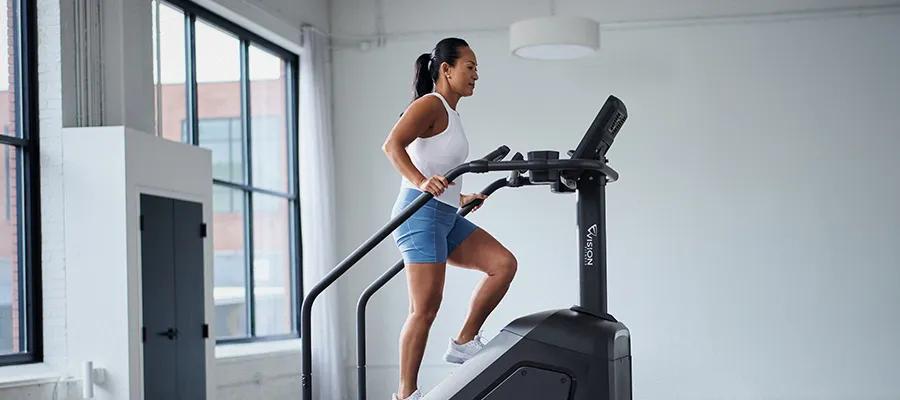
We’ve all heard the advice. Stand more. Walk more. Park farther away. Take the stairs instead of the elevator. But does stair climbing really make a difference for health and fitness?
Yes, it does. That’s why stairclimbers (also known as step mills, stair mills, climbers and steppers) remain one of the most used cardio options in commercial facilities.
While there are many reasons to include a stair climber on your floor, here are the ones members respond to most.
1. Get Fit in Less Time
Stairclimbers support short, effective workouts and deliver strong cardiovascular demand in less time, which matters to members balancing busy schedules.
Research shows that even brief stair-climbing sessions can lead to meaningful fitness gains. In one eight-week study of middle-aged adults, participants completed two-minute stair-climbing sessions during the workday. Sessions started at once per day and progressed to three per day. Fitness levels improved by nearly 10 percent with less than 30 minutes of weekly exercise.
This means that facilities can provide opportunities for quick workouts that yield great results, ultimately improving member satisfaction.
2. Improve Overall Health
Facilities can support members’ long-term health goals with equipment like the stairclimber which supports heart health, cardiovascular function and metabolic health.
Members feel it quickly. Heart rate rises. Breathing deepens. Body temperature increases. Early sessions feel challenging, especially after time away from cardio workouts. Over time, the heart and lungs become more efficient and recovery improves.
In one study of women completing two-minute stair-climbing sessions, participants increased frequency from one session per day to five. Compared to a control group, stair climbers lowered cholesterol by an average of 7.7 percent and improved VO₂ max by 17 percent.
Other research shows that walking stairs for three minutes one to three hours after a meal can help lower blood sugar levels.
3. Enjoy the Benefits of Running at a Lower Impact
Stair climbing provides a demanding cardio workout with less joint stress than running. Moving upward places less impact on knees, hips, shins and the lower back than repetitive flat-surface running, ensuring that joint-sensitive members can still get a challenging cardio workout without injury. Handrails also allow members to offload some body weight if needed.
Former competitive runner Suzy Walsham turned to stair climbing after repeated impact injuries. She describes vertical running as more demanding on heart rate and muscles, yet easier on the body overall.
When running on flat ground, impact forces can reach two to three times body weight. Stair climbing reduces that impact while still challenging the cardiovascular system.
4. Protect Knees and Support Long-Term Joint Health
Healthy knees support everyday movement: standing, walking, sitting, hiking, climbing.
Stair climbing reduces knee stress compared to real stairs because there is no downhill step. That removes a common source of joint strain while maintaining the same movement pattern.
Strengthening glutes, quads and core muscles also supports proper hip and knee alignment. Stair climbing plays a role in that balance. For members with existing knee conditions, stair climbing may not be appropriate. A physician should always guide those decisions.
5. Increase Glute Strength
The gluteal muscles drive hip extension and support daily movement and athletic performance. Stair climbing activates the gluteus maximus significantly more than treadmill walking.
Research shows stair-climbing movement activates glutes up to 50 percent more than walking. The lower portion of the gluteus maximus works hardest during ascent, which supports strength, tone and endurance.
That activation is one reason stair climbing machines remain popular with athletes and physique-focused members.
6. Condition the Core
Stair climbing engages the core when posture is maintained.
An upright torso, light hand contact and controlled movement activate abdominal muscles, obliques and stabilizers. Fatigue can lead members to lean heavily on handrails. That reduces benefit and shifts effort away from the core.
To support your members and help them get the best stair climbing workout, always encourage good posture.
7. Support Bone Density
Weight-bearing exercise helps maintain bone mass and reduces osteoporosis risk.
When muscles apply force to bone, the body responds by strengthening bone tissue. Stair climbing creates repeated, controlled loading that supports this process.
While impact intensity matters for bone growth, stair climbing still plays a role in maintaining bone health, especially when combined with other strength and load-bearing activities.
8. Ideal for Cross-Training
Repetitive movement increases injury risk. Cross-training reduces it.
Stair climbing activates muscles that may be underused in sports like cycling, swimming or rowing. It engages glutes, quads, hamstrings, calves, ankles and core.
For runners and high-impact class participants, stair climbing offers a lower-impact cardio option on recovery days. It also provides weight-bearing stimulus missing from non-impact sports.
9. Reduce Fall Risk and Improve Stability
Stair climbing challenges balance by requiring single-leg support on every step.
That movement recruits stabilizing muscles in the foot, ankle and lower leg. Stronger lower-leg musculature improves foot placement and reduces injury risk.
Research shows stair climbing activates lower-leg muscles more than elliptical training. That matters for balance, stability and fall prevention, especially as populations age.
10. Real Movement for Real Life
Stair climbing mirrors daily movement patterns.
Members climb stairs at work, at home and while traveling. Training that movement supports confidence and independence over time.
For members who enjoy walking trips, hiking or active travel, stair climbing helps prepare the body for longer durations and elevation changes.
11. Easy for All Fitness Levels
If you can climb stairs, you can use a stairclimber.
Stairclimbers feels familiar and intuitive. That lowers barriers for beginners while still challenging advanced users. Speed control allows members to start slowly and progress safely.
As comfort increases, members can adjust pace, add intervals or extend workout duration.
12. Burn Calories and Support Fat Loss
The stairclimber works large muscle groups. Larger muscles require more energy.
Harvard Health Publishing reports that 30 minutes of stair stepper use burns approximately:
180 calories for a 125-pound person
216 calories for a 155-pound person
252 calories for a 185-pound person
Actual results vary by speed, fitness level and individual metabolism. Stair climbing supports both interval-based and steady-state training approaches.
13. Fits Efficiently on the Cardio Floor
While the footprint of commercial stair climbers vary, the Vision Fitness Summit Stairclimber uses space efficiently compared to competitors and other cardio options. A compact footprint allows facilities to maximize layout without sacrificing workout value.
Ceiling height should be considered, as stairclimbers add height at the top step. During use, the user remains lower as the stairs rotate continuously.
14. Plenty of Workout Variety
Built-in programs help keep workouts fresh and give staff easy talking points for member engagement by providing variety and progression.
Members can choose interval training, goal-based workouts or steady climbing. As fitness improves, intensity increases naturally.
Entertainment and destination-based programs add engagement for members who prefer visual motivation or structured challenges.
15. Members Feel Better After Using It
Exercise supports mental health. Stair climbing releases endorphins that reduce stress and support mood.
The need to focus on each step encourages present-moment attention. That awareness can reduce mental fatigue and stress.
Members may feel tired after a stair-climbing workout. Most feel accomplished and energized, which encourages them to return to both your facility and to the stairclimber.
Final Thoughts
The stairclimber is more than just another cardio machine. It is a proven solution within a well-rounded cardio offering that delivers what members care about most: results. Functional, familiar, and efficient, it is easy to adopt across age groups and fitness levels. By offering stair climbing in your facility, you strengthen your overall cardio lineup with a low-impact option that delivers lasting value for both your members and your equipment investment.
Research Referenced
British Journal of Sports Medicine: Stairclimbing and Cardiovascular Health
National Library of Medicine: Aerobic Performance
American Diabetes Association: Diabetes Care
National Library of Medicine: Impacts of Treadmill Running
World Health Organization: Musculoskeletal Health
Harvard Health Publishing: Calorie Burning
wbur: Switch from Track to Stairwells
National Library of Medicine: Health Effects of Stairclimbing
British Journal of Sports Medicine: Stairclimbing and Glucose Levels
National Library of Medicine: Hip Muscles Action During Stairclimbing
National Library of Medicine: Benefits of Physical Exercise on Bone Density
National Library of Medicine: Worldwide Projections for Hip Factures
Orthopedics New England: Ankle Sprains
National Library of Medicine: Ankle Sprains
John W. Brick Mental Health Foundation: Move Your Mental Health
Mato Clinic: How Exercise Eases Symptoms of Depression and Anxiety